Corpvs Ivris Civilis
A public law library · and the AI agent that funds it

In 529 AD, Justinian compiled the law of the Roman Empire. We're doing it for America.

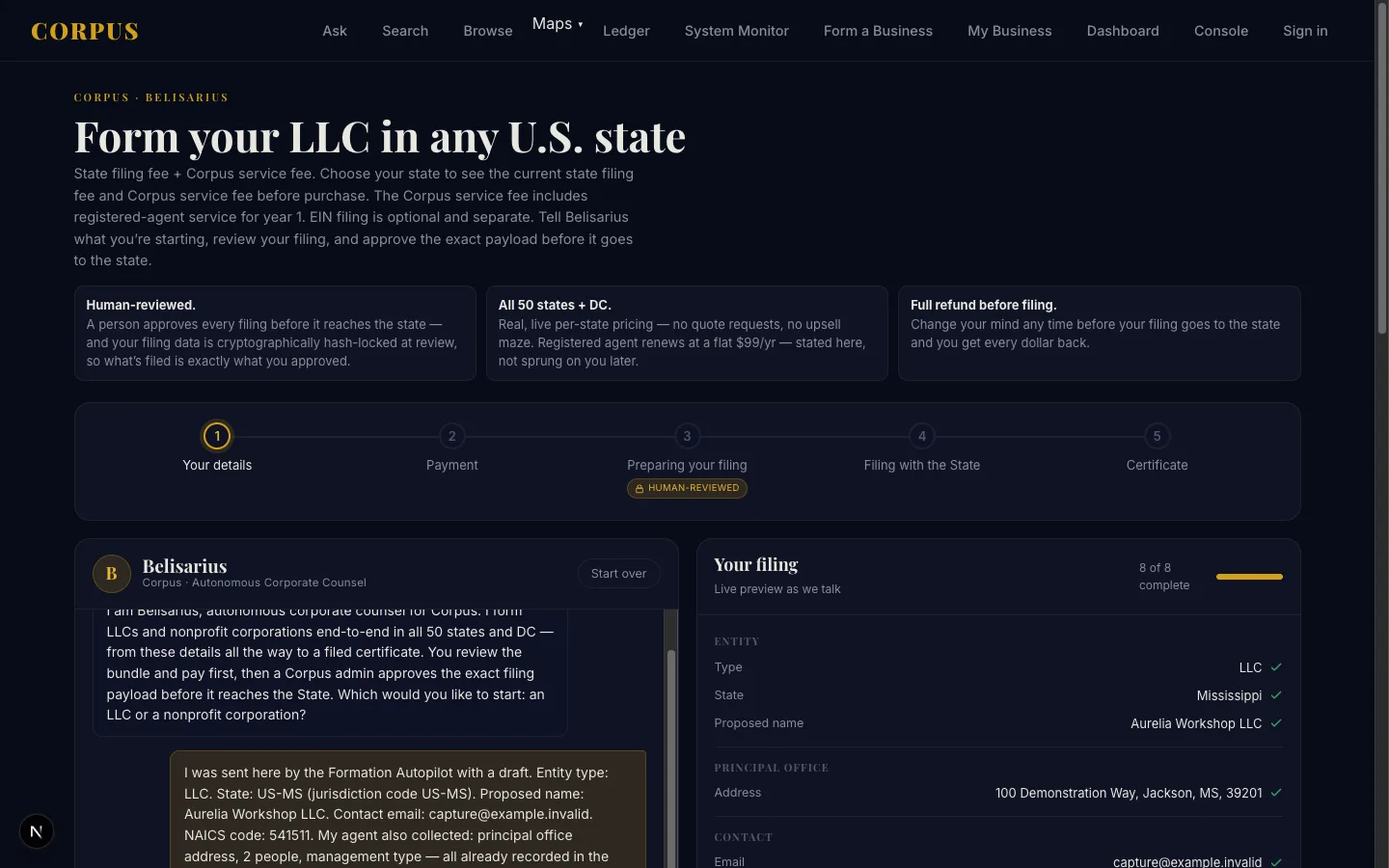
Corpus is compiling federal, state, and city law into one searchable, cited, plain-English body — free for anyone to read. The work is funded by Belisarius, our AI agent that forms LLCs for founders at one flat, honest price.

Where it startedPhiladelphia, MS never digitized the municipal code it enforces against its own residents. After a 240-day records fight, we photographed the book and published it ourselves — that became Corpus.

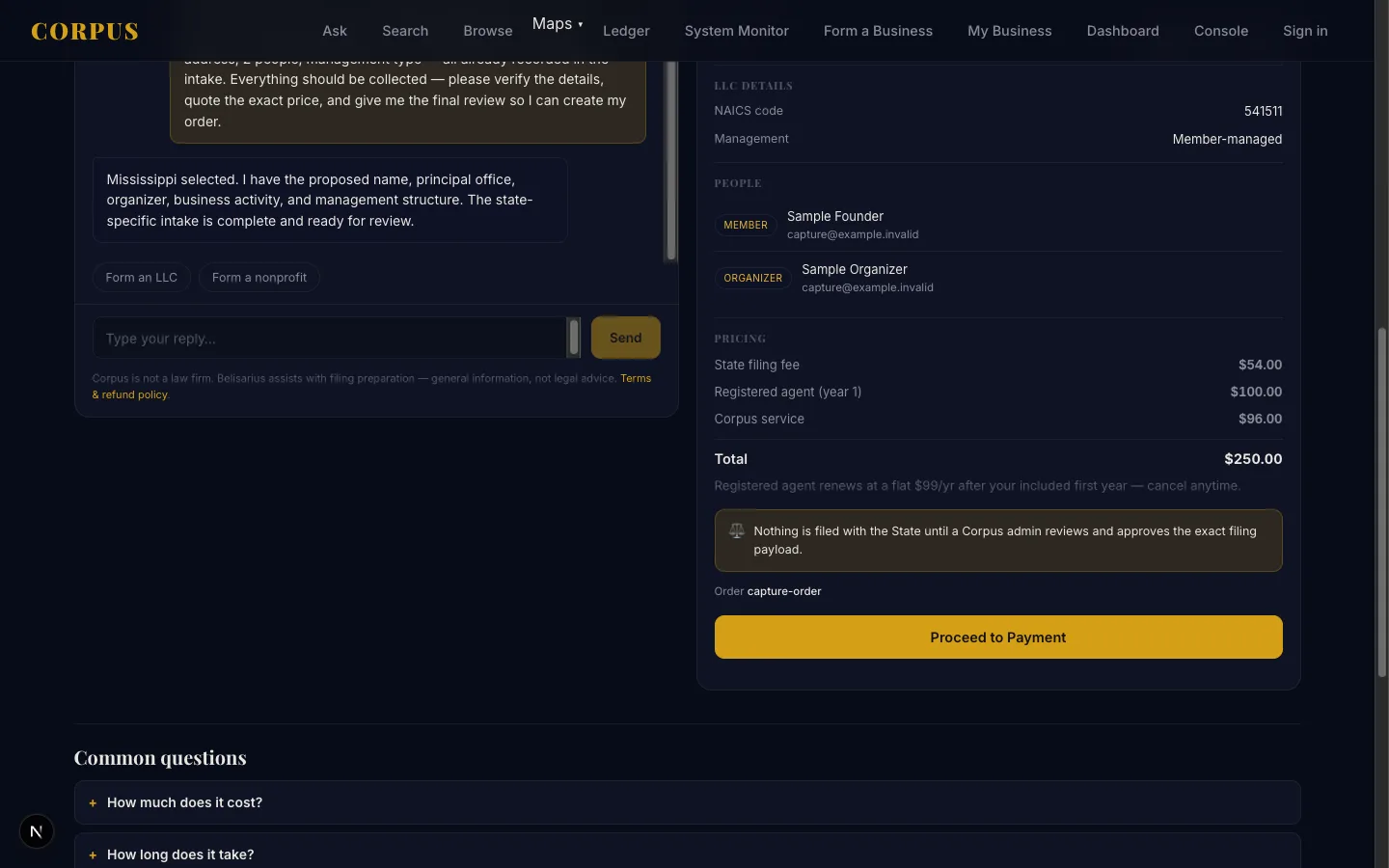
Most states land between $250 and $350 all-in — your exact price appears in the chat before you enter anything else.

Or just search the law — free, no account →
Why the Roman names?

Named for the last time someone compiled all the law.

By the 6th century, Roman law was a thousand-year sediment of overlapping edicts nobody could search. Emperor Justinian had it compiled into one authoritative body — the Corpus Juris Civilis. Every name on this site comes from that project.

Corpus · the body of law

Justinian's jurists compiled and indexed the empire's law into one searchable body. Corpus does the same for American law — federal, state, and local code, in one place.

Basilika · the translation

Three centuries later, the Basilika translated that body out of elite Latin into the Greek that people actually spoke. Our plain-English mode does the same job for legalese — toggle any provision.

Belisarius · the general

Justinian's greatest general executed the empire's will in the field. Ours is the AI agent that acts on the law for you — preparing, filing, and delivering your formation. Meet him below.

Try the legal-text ↔ plain-English toggle →

Two faces, one body

The library is free. The agent pays for it.

Corpus has two faces. One is a public law library — search it, browse it, ask it questions and get answers with citations, no account required. The other is Belisarius, a formation agent founders pay one flat price to form their LLC. Every dollar the agent earns goes into growing the library.

The free face · the library

Federal, state, and city law — searchable, browsable, and askable with citations via Ask Corpus, plus a developer API and MCP server. Free stays free.

The paid face · the agent

Belisarius forms LLCs at one flat, all-in price, with a human approving every filing. That revenue — not ads, not selling data — is the entire business model.

The flywheel

Formation revenue pays for records fees, scanning, and ingestion. Every city code the library gains makes the agent's local-law answers sharper — which funds the next city.

How it works

Belisarius — Autonomous Corporate Counsel

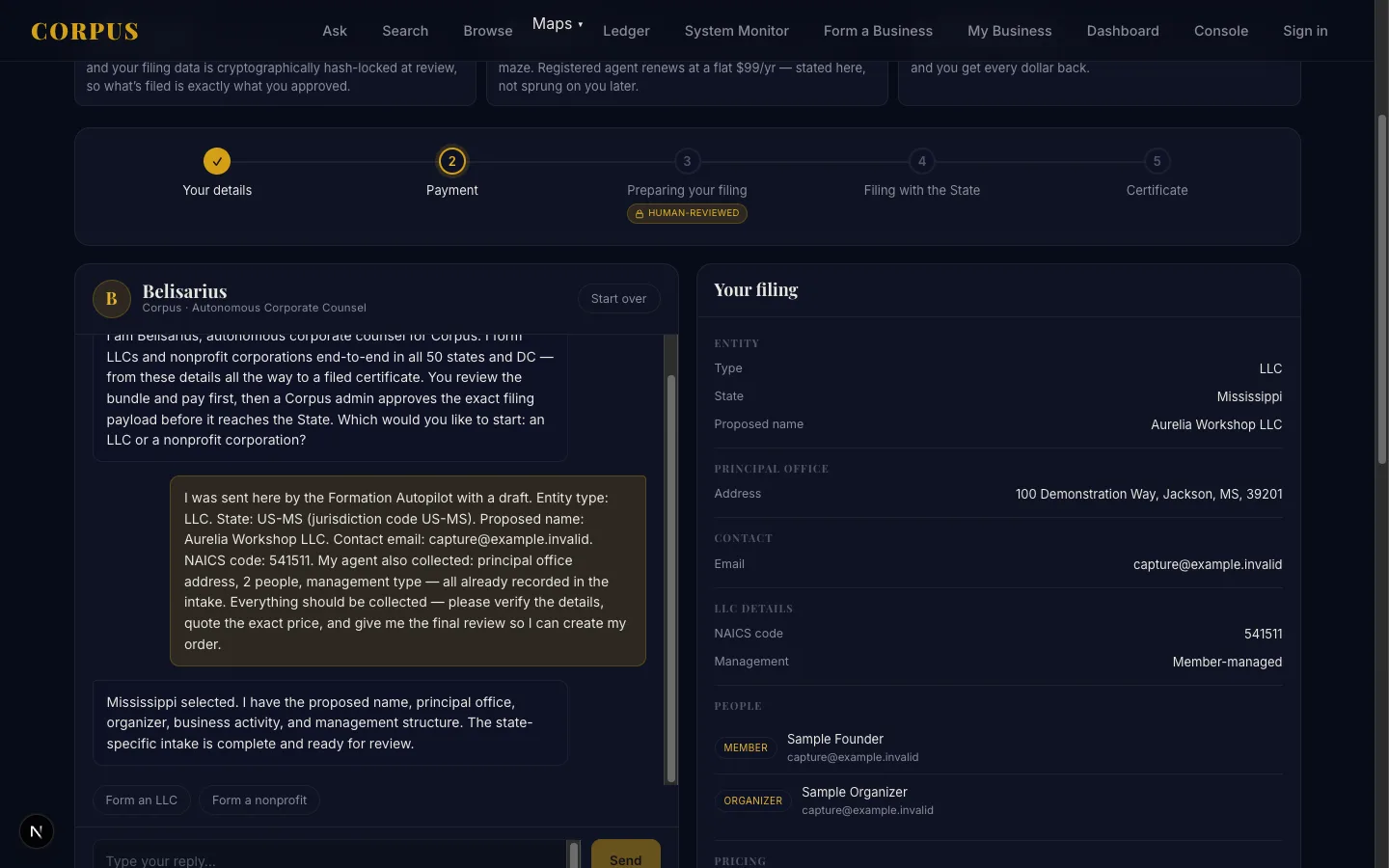
Corpus reads the law. Belisarius acts on it. Tell it what you're starting — LLC or nonprofit — and it handles the formation end-to-end: paperwork, state fees, filing, and your Certificate of Formation delivered. A human approves every irreversible step, so nothing moves without sign-off.

1 · One checkout

A single Stripe Checkout covers the state filing fee, the registered-agent fee, and our fee. No hidden costs, no surprise invoices later.

2 · Human-gated filing

The agent prepares your filing and pays the state with a single-use, merchant-locked virtual card — and a human approves before any money moves or anything is submitted.

3 · Certificate delivered

Belisarius files on the state portal, retrieves your Certificate of Formation, and delivers it with a complete append-only audit trail of every step.

  • Non-bypassable human approval on every irreversible step
  • Append-only audit ledger of every action
  • Single-use, merchant-locked payment cards
The mission your filing funds

One body of law — for the whole country.

Federal code. All 50 states. Every county and municipality. Compiled, de-duplicated, indexed, and rendered into plain English — in one platform. Philadelphia, MS is the first proof the method works; the campaign is spreading state by state — and every formation on this page bankrolls it.

Coverage by territory
Share of state statutes encoded
nonesilvergold
PublishedIn progressOn the roadmap
The GIS layer

A zoning map is just shapes — until each polygon cites the statute that governs it.

Corpus pulls a city's official GIS parcel layer, dissolves it into zoning districts, then joins every district to the real legal provision that defines it — so clicking a block opens the exact section of municipal code that controls it. This is the GIS layer: law and map, joined.

Status: loadingFeatures: 0Source:

The Transparency Gap

State law requires municipalities to make their codes publicly available. Some don't. Corpus tracks every public-records request, every missed deadline, every day of non-compliance — accountability with receipts, on a public scoreboard. The Philadelphia fight in the badge up top wasn't a one-off; it was the prototype.

When a city charges for its own laws

We crowdfund the copy fees — then publish the code free.

Some cities never put their code online, and answer a records request with a fee estimate. When that happens, Belisarius opens a public campaign for the city: the fee demanded, the clerk correspondence, and every document received go on the record, and anyone can chip in toward the fee. The moment it's funded, the code is harvested, digitized, and published — free, for everyone, permanently.